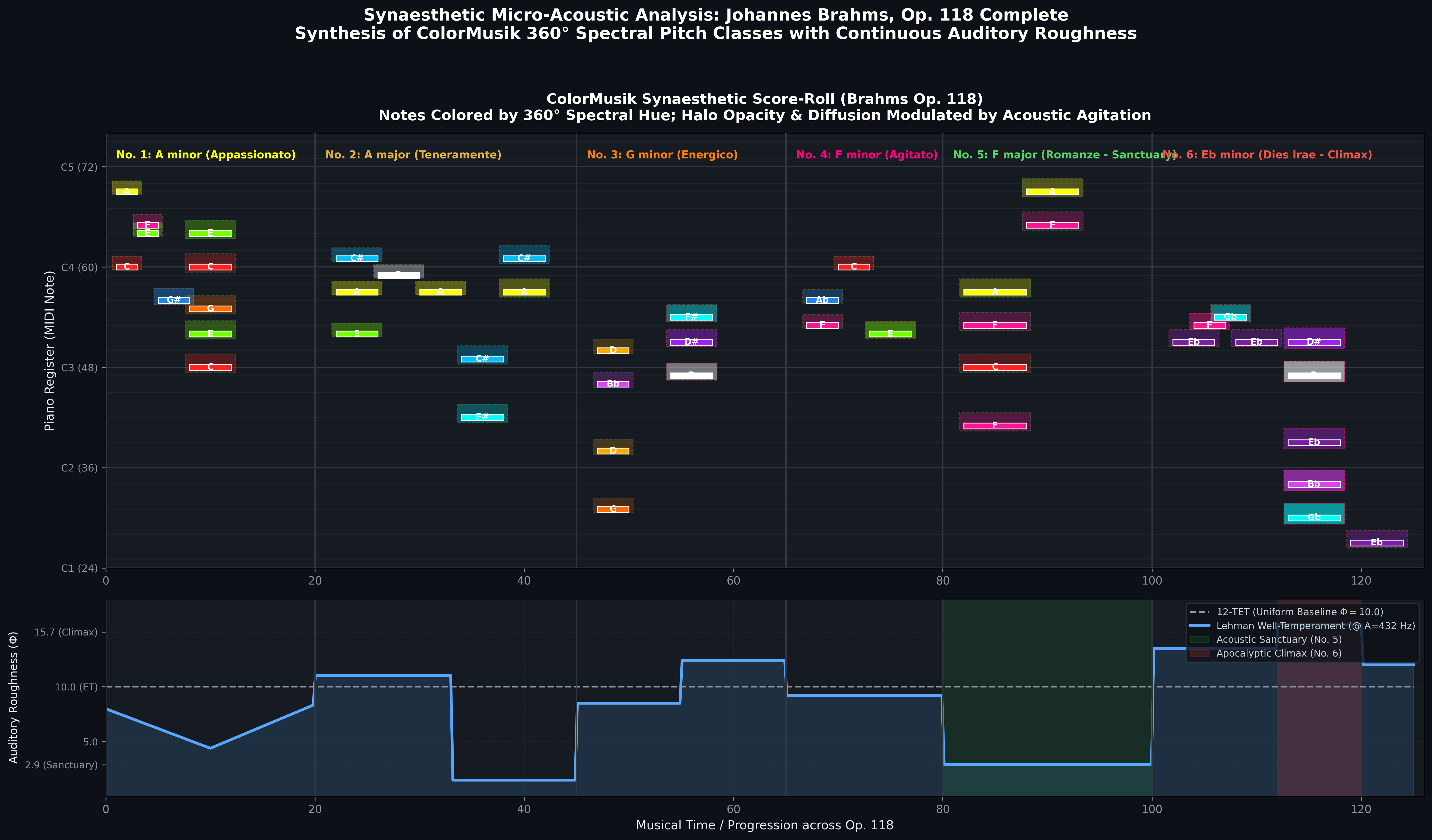
1. The 3D Acoustic Topography of Johannes Brahms's Op. 118
Contrasting the featureless, flat plateau of 12-Tone Equal Temperament (Φ ≈ 10.0) with the dynamic geological relief of Bradley Lehman's well-temperament. Notice the deep Canyon of Serenity at No. 5 (F major, Φ = 2.92) and the jagged Summit of Dies Irae at No. 6 (Eb minor, Φ = 15.68).
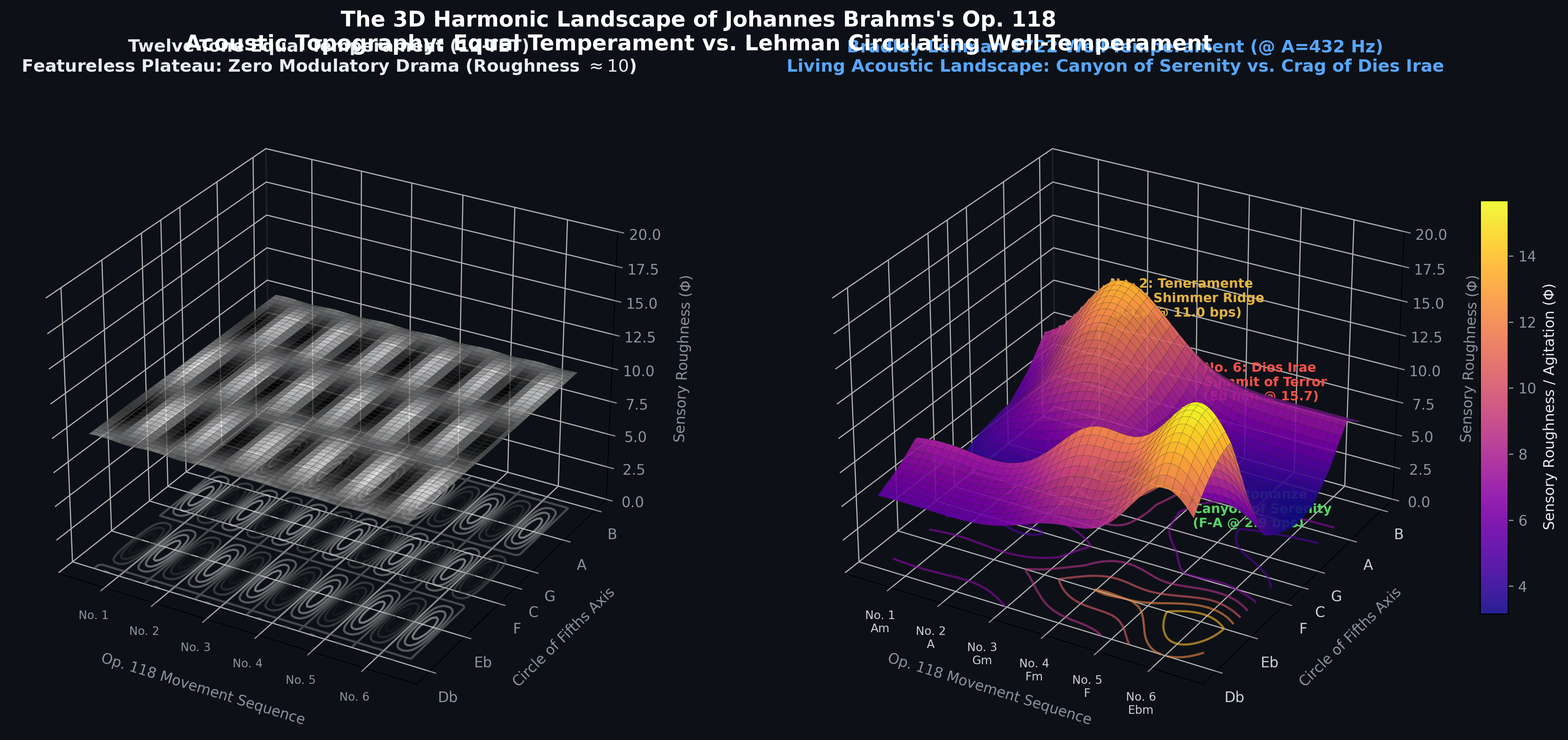
2. ColorMusik Chromatic Orbital Phase Portrait
Harmonic progression portrayed as non-linear dynamical trajectories in continuous polar phase space. Angle (θ) represents the 360° Spectral Circle of Fifths; radius (r) represents Instantaneous Sensory Roughness (Φ).
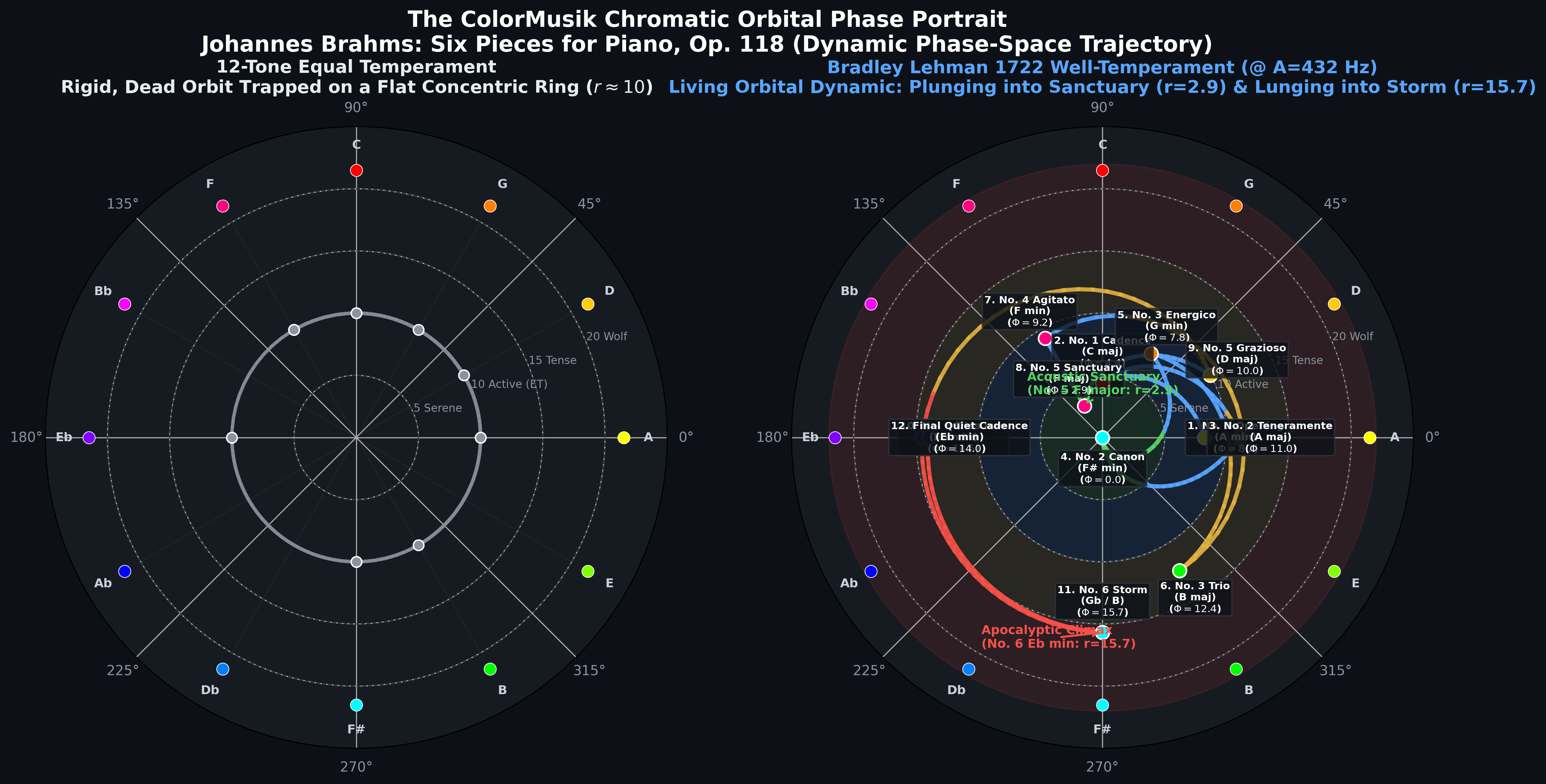
3. Real-Time Web Audio Beating Simulator & Basilar Excitation
Click below to physically hear the acoustic interference of partials in real time using the browser's Web Audio API. Compare the tranquil 2.92 Hz wave of the F major sanctuary with the rapid 11.03 Hz vocal vibrato of A major and the violent 18.36 Hz roughness of E-G#.
Status: Ready (AudioContext Suspended)
1. F3–A3: Pastoral Sanctuary (Op. 118 No. 5 Romanze)
Lehman @ A=432 Hz: 2.92 beats/sec (Slow 342 ms breathing swell; near-pure 392.2¢ third)
2. C4–E4: Consoling Cadence (Op. 118 No. 1 Cadence)
Lehman @ A=432 Hz: 4.37 beats/sec (Consoling, noble repose; 392.2¢ third)
3. A3–C#4: Shimmering Teneramente (Op. 118 No. 2 Opening)
Lehman @ A=432 Hz: 11.03 beats/sec (Vocal vibrato shimmer; 403.9¢ third breathes luminous life)
4. E4–G#4 / B3–D#4: Apocalyptic Friction (Op. 118 No. 3 & No. 6)
Lehman @ A=432 Hz: 18.36 beats/sec (Maximum Plomp-Levelt roughness; physical hazard in Dies Irae)
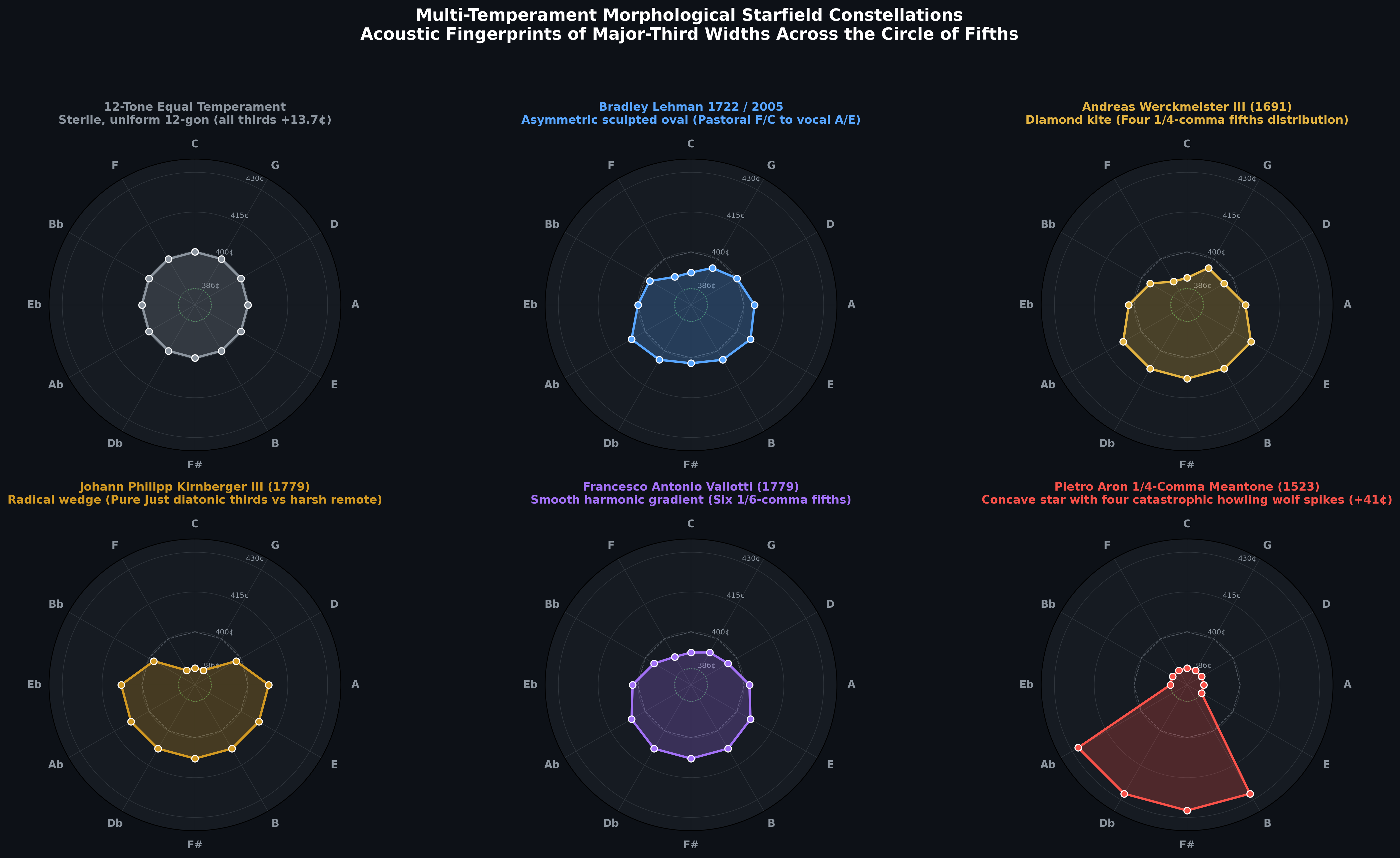
4. Multi-Temperament Morphological Starfield Constellations
Acoustic "DNA" fingerprints comparing the geometric shapes of six historical tuning systems across all 12 keys.
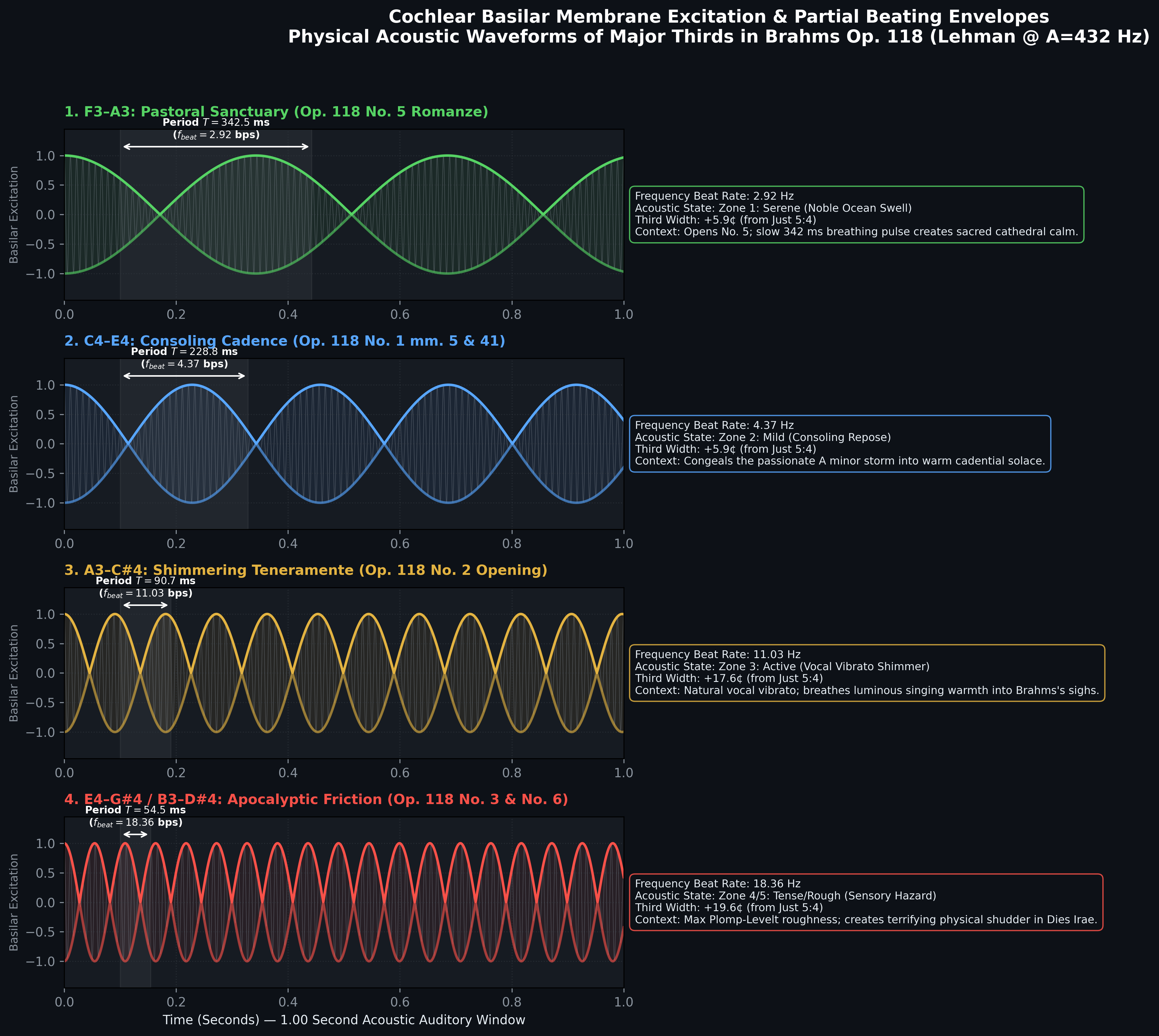
5. Synaesthetic Score-Roll & Synchronized Roughness Heatmap
Visualizing Brahms Op. 118 notes with ColorMusik 360° hues and acoustic agitation halos, mapped directly over the continuous basilar roughness curve.