Brahms: Klavierstücke, Op. 118
When Johannes Brahms completed his six Klavierstücke, Op. 118, in the summer of 1893 at Bad Ischl, he entrusted Clara Schumann with what would become his most intimate testamentary cycle. Yet the standard twentieth-century consensus—that equal temperament provides an innocent, transparent canvas for these masterpieces—flattens their fundamental acoustic drama into geometric uniformity. When tuned instead to the circulating temperament documented by Bradley Lehman from J.S. Bach’s 1722 Well-Tempered Clavier scroll, every key awakens with a radically individualized acoustic anatomy.
In equal temperament, every major third is held at a sterile, uniform width of 400 cents, beating uniformly with entire disregard to emotional intentions. In Lehman’s circulating architecture, however, the harmonic landscape possesses living breath. The pastoral third of F major (F–A) purrs with celestial sweetness at an almost-pure 392 cents, while the opening of the G minor Ballade (No. 3) relies on a mellow B♭–D third (398 cents, beating at a gentle 6.5 Hz). But when Brahms plunges into the central B major Trio, the third flares open to an incandescent 406 cents, thrashing at 13.6 beats per second. The emotional tension is not merely a cognitive concept—it is a physical, thermodynamic event occurring within the piano’s soundboard.
Tuned in historical concert alignment to the Italian Diapason Normal of A = 432 Hz—ratified by Giuseppe Verdi and the 1885 Vienna Pitch Conference—the instrument sheds the brittle string tension of modern A = 440 or 442 Hz. The lower pitch allows the belly of the instrument to sing with visceral warmth, granting the dense, lower-register Brahmsian sonorities transparent clarity.
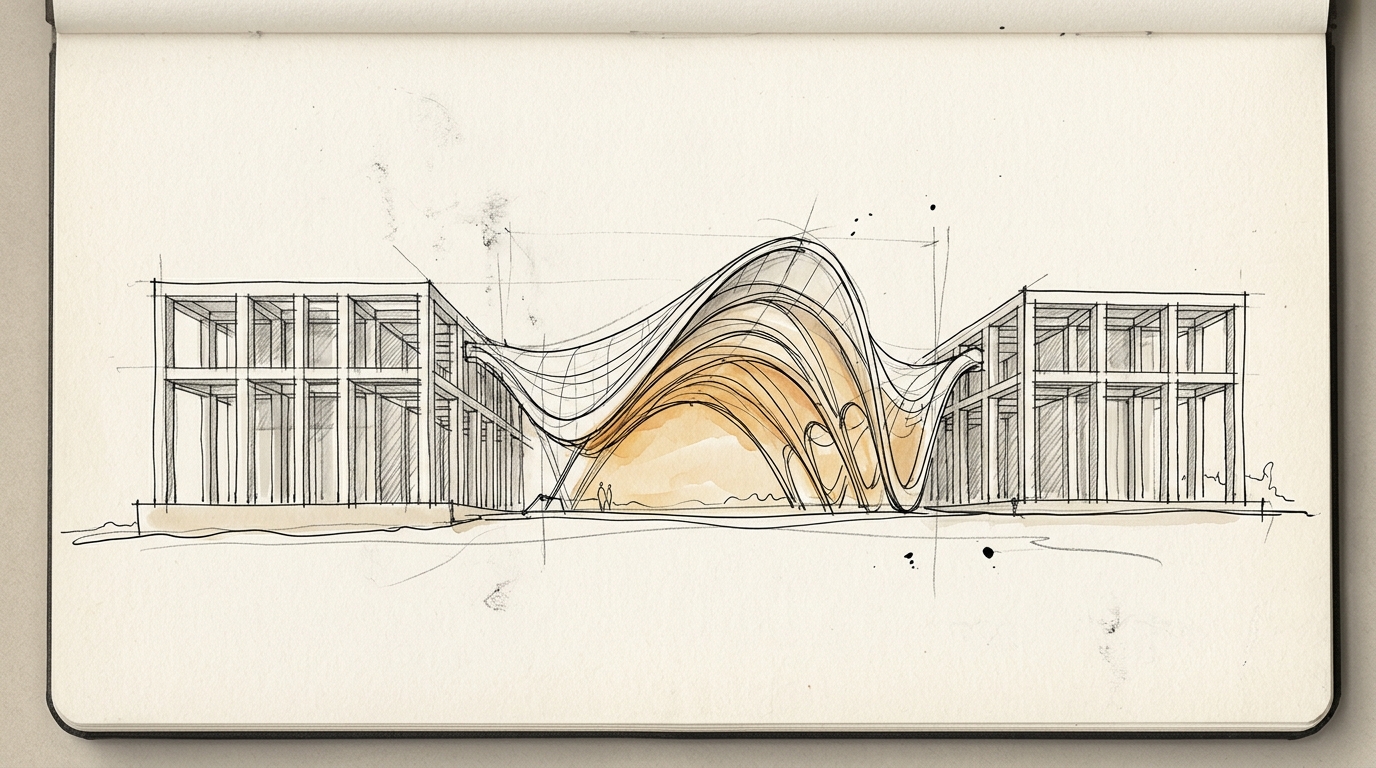
In classical ternary structure, musical form operates not as static symmetry, but as a lived temporal journey: orientation, displacement, and recollection. The opening section establishes an architectural datum—a grounded sense of home, structural mass, and tonal gravity. The middle excursion suspends that datum through dynamic contrast, soaring vertical release, or kinetic acoustic turbulence.
When the opening returns as A′, it is never an untouched mechanical repetition. As spatialized in the concept elevation above, the return honors classical symmetry in proportion and mass, yet stands irreversibly altered by the memory of the wave it traversed—a physical parallel to Brahms’s whispered smorzando recapitulations. The full theoretical framework and built architectural case studies are examined in Monograph VI →
The Research Corpus & Critical Commentary
A Generous Collection of Articles Mostly Written By AI
The Dramaturgy of Unequal Temperament in Brahms Op. 118
Acoustic agitation, comma distribution, and key individualities in the late intermezzi. How unequal thirds create structural drama.
The 1885 Vienna Pitch Conference & Verdi A=432
Diplomatic realpolitik, historical pitch standards, and Brahmsian piano voicing practice in late nineteenth-century Vienna.
Painted Keys: ColorMusik Spectral Agitation Zones
Harmonic chiaroscuro, perceptual tension metrics, and affective color systems from Charpentier and Schubart to Rita Steblin.
The 24-Key Steblin Historical Color & Affect Matrix
Complete compilation of treatises (Schubart, Mattheson, Beethoven) paired with exact Lehman M3 comma width and triad beating metrics.
Setting the Bach-Lehman Circulating Temperament
The Piano Technicians Journal workshop tuning protocol for concert technicians setting Lehman (1/6 and 1/12 comma fifths).
Acoustic Agitation Index (Φ) & Harmonic Syntax
The mathematical and psychoacoustic formula quantifying dissonance and harmonic tension in circulating systems.
Architectural Manifestations of Musical Ternary Form (ABA)
Deep research report: spatialized tonal modulation, the promenade architecturale, and asymmetric memory from Piano and Aalto to Steven Holl.